Back in 2006, my dear friend and neighbour Ami McKay wrote an amazing, and bestselling, novel, The Birth House, which caught the public's imagination here in Canada, in the US, Britain, and other parts of the world. Set right here in Scotts Bay at the turn of the 20th century, it was translated into at least two other languages and bumped The DaVinci Code out of the #1 spot on the Globe & Mail's bestseller list. It was (and is still) an amazing, enthralling, riveting read, and I was thrilled to watch Ami's success. She's currently in the editing/revising phase for her second novel, for which we're all anxiously awaiting. (no pressure, Ami, really...).
In the summer of 2006, Ami asked if I'd take part in a blog tour that she was hosting. As the goofy garden writer who lives up the hill from her, I thought it would be a great idea to write a bit about the herbs and other plants that would have been used by the community midwife, who in The Birth House is named Marie Babineau. So here, for your Sunday morning reading pleasure, is that post, with the addition of a few photographs (back then we had no highspeed up here in Scotts Bay) The book is still very much available, and I still utterly recommend it: it is one of my favourite novels of all time. The Acadians who came to what is today Nova Scotia in the years between 1604-1755 brought many of their own plants with them to develop their potager gardens for medicinal, food and other useful plants. These kitchen gardens were usually very precisely laid out in geometric shapes, but include attractive ornamental plants as well as utilitarian species. There are wonderful examples of Acadian potagers at
Grand Pre National Historic Site ,
Annapolis Royal Historic Gardens , and at the
Acadian Museum of Southwest Pubnico .
Being of good Acadian stock, Miss Babineau would have grown traditional vegetables including string beans and peas, onions, and root vegetables such as sunroot (Jerusalem artichoke), beets, turnips, carrots and radish. There would be raspberries, gooseberries and currants for drying and making into preserves, and a host of herbs for tending the community’s ailments—wormwood, lovage, sage, lavender, chamomile, catnip, calendula, angelica and dill…Some plants she would have foraged for in the woods and meadows and along the seashores and roadsides; blackberries, chokecherries, sumac, spruce gum, willow and more.
Here’s a panier-basket of plants, a few of them cultivated and but most gleaned from mother Nature’s bounty.
Angelica: Marian Zinck in the lovely book
Wildflowers of Nova Scotia, New Brunswick and Prince Edward Island (published by Formac, newly revised and updated in 2006) writes that chewing the root of angelica was formerly thought to ward off witches. More practically, angelica is often candied or made into a cordial.
Red Clover: a lovely plant for hay and to attract bees, it also makes a wonderful tea when the flowers are dried.

Bunchberry: (Cornus canadensis) Also called crackerberry, these attractive wild perennials produce orange-red berries, bland unless cooked.
Curled Dock (Rumex crispus): The root of this often weedy plant have been used to treat skin afflictions
Winterberry (Gaultheria procumbens): both the leaves and brilliant red berries of winterberry taste of wintergreen and are very tasty.

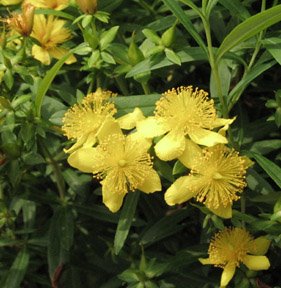
St. John’s Wort (Hypericum punctatum): Once thought to suppress urine output and relieve kidney and bladder problems when made into a tea. Also formerly used as an ointment to ‘dispel hard tumours, caked breasts, bruises, etc.’ Now known to be effective in treating depression and sleep disorders.
Dandelion: Never shun the humble dandelion, also called pissenlit or pissabeds, perhaps for their brilliant yellow colour or for their usefulness as a diuretic. The leaves are a good potherb, the roots roasted and ground are used as a coffee substitute, and of course the flowers make the heady and potent dandelion wine.

Wild roses (Rosa virginiana, R. carolina and others): The ripened fruit, or hips, of wild roses contain much vitamin C and are delicious in jellies, salads or teas.
Dogwood (Cornus alternifolia): the bark of this and other dogwoods was traditionally used by both French and First Nations peoples, mixed with tobacco for lessening that herb’s strength when smoked.
Hawthorns (Crataegus, various species): The small fruits of hawthorns, often referred to as wild medlars (including by Lescarbot at Port Royal in 1609) though sometimes not very flavourful, were known to be of use against scurvy, but also supposedly good to prevent the menses and other ‘fluxes of bloud’ as well as for bladder ailments.

Service Berry, Chuckly Pear (Amelanchier, especially A. canadensis): This large shrub or small tree produces juicy, pear-like fruits about the size of large blueberries, luscious in taste and formerly much used in making preserves, cordials and even a delightful liqueur not unlike cassis.
Mint (Mentha, various species): Mints have long been used in soothing teas as well as in flavouring cooking, bringing ease to a distressed stomach and relief to cough and cold, itching of the skin and various other malaises.

Coltsfoot (Tussilago farfara): Firstflower of spring, its bright yellow, dandelion-like blossoms appear before the thick shiny leaves, which are boiled to make very effective cough syrups and lozenges.

Labrador tea: (Ledum groenlandicum) Although the leaves are bitter, they are often used to make a soothing tea to releeve colds, coughs, and other ailments. Literature reports that a tincture of the plant was useful in relieving the sting of insects, as well as comforting those with rheumatism. Interestingly, the plant has also been used to dye material a brown colour!
Wild cranberry (Vaccinium oxycoccus, V. macrocarpon): One of the most useful wild fruit for preventing or treating scurvy, they were called Atoca by the first Nations peoples who introduced them to the French explorers and settlers.
Cattail: (Typha angustifolia, T. latifolia) An all-purpose and valuable plant, the pollen of which has been used as a flour substitute; the roots are edible, high in starch and sugars and useful in a syrup for fevers, as a poultice on sores and scalds. The fibre has been used in past years to make a type of burlap while the fluff of the flowerheads was often used as a kind of insulation.

Valerian: One of the herbs Miss B’s ancestors would have brought with them from France, and now widely naturalized, it is useful in promoting sleep and in calming nervous conditions. (Funny that Dr. Thomas didn’t use it in conjunction with his recommended vibrator treatments!)
Note: The previous aside is an inside joke and you'll just have to read the book in order to appreciate the humour in it.Willow (Salix species): Willows are the natural source of acetylsalicylic acid, the foundation of painkillers such as aspirin. Chewing the leaves or bark would relieve symptoms of arthritis and other painful conditions.

Glasswort, samphire greens: (Salicornia maritima) This succulent little plant grows on saltmarshes, and is quite edible, but the interesting thing about it is that when burned, its ashes can be used in the soapmaking process. Acadians on the French shore of New Brunswick refer to the plant as titis de souris, or mousetits! (
illustration from Wikimedia Commons, as I don't have a good photo of this plant.)