Showing posts with label foliage. Show all posts

15 December 2014

Gold foliage for brighter gardens

Hello, fellow gardeners! Where have I been, you ask? Well, it's been a busy, busy few months, with lots of projects on the go. Now, with only 10 days til Christmas, the main deadlines are under control so I can do some catchup tasks, including updating my neglected blog. It's like that for gardeners, though, so often: during the main gardening months we're outside in our gardens, planting, weeding, harvesting, puttering, designing. Now that frost has come and things have stopped growing and we've gotten our bulbs planted (yes! I did! Before December, even!) we turn to the season of indoor gardening, which includes, of course, planning for next year.

When I was a plant science student at the Agricultural College, to see yellow in foliage often suggested a nutrient deficiency or other problem. It took me a long time to embrace the colour gold, or cream, or yellow, in ornamental plants, but here's what turned the tide for me:
Hostas. Of course it would be hostas, with their splendid foliage that utilizes only a few colours--cream, green, yellow, blue--in such dramatic ways. I love the flowers of hostas, too, but the fresh, perfect foliage is what really does it for me. They are calming plants with their tidy clumps of leaves (especially if they're slug-resistant or you've done battle to keep slugs at bay), and if you have a shady spot, they really brighten it up. It's true that deer adore hostas so if you live in an area where deer are a problem, you may have to opt for hostas only in containers out of reach of hungry bambis. 

Pretty much any plant with gold foliage is best suited for a partially shaded site; from a practical point of view, many need some protection from full sun sites because their foliage will otherwise burn. The golden colour just glows in a shaded garden, as demonstrated with this 'Dickson's Gold' campanula. 
Many gold-foliaged plants include the name 'aurea' in their botanical or cultivar names. This is a golden form of meadowsweet (Filipendula ulmaria 'Aurea'), which does well in dappled shade in my garden.

Because I went to the Agricultural College where the school colours were blue and gold, I do have a particular fondness for that colour combination (even when the blue is more lavender, but you get the point). This is creeping speedwell Veronica prostata 'Aztec Gold', which has been a good performer for me.
 This is the spiderwort Tradescantia 'Blue and Gold', also sometimes also called 'Sweet Kate'. It was one of the first replacement plants I purchased to put in my new garden because I so love it.
And this is Brunnera 'Diane's Gold'. I had it for several years but didn't take it with me when I left my former home, and haven't sourced it again. I miss it, as it did very well under the azalea where it was planted.
Plants that are bombastic or invasive in one area of the country (and beyond) are not necessarily so in other areas. This is Tansy 'Isla Gold', a golden leafed form of the common wildflower tansy. It is a vigourous grower but easy to control, and it's deer resistant to boot. Some like to dry the flowers to use in arrangements and wreaths. 

Sometimes, new cultivars of a perennial or shrub fail to perform up to a gardener's standards, and disappear quietly from catalogues after a couple of years. I was initially suspicious of 'Eos' geum, but it has done very well for me--I had it in my previous garden and planted it again last year in my new yard, and it grew beautifully. The bright orange flowers contrast fantastically with the gold-green foliage.
I really like weigelas, although I have yet to add any here in my new garden. When I do add one next year, it will be this golden-leafed form, 'Rubidor', which I had in the past and absolutely loved. You'll also find several other cultivars available, including 'Jean's Gold' and 'Ghost', depending on where you live, and where your nurseries source their plants.
To wrap up this post on gold foliage, I leave you with one of my favourite trees: Metasequoia 'Ogon', aka 'Gold Rush', the golden dawn redwood. The dawn redwood is a star in my books in its normal, green foliaged form, but this one leaves me breathless at its beauty. It absolutely glows, and it can take full sun, to boot.

Where do you fall on the spectrum with golden leafed plants? Love or not?

13 November 2011

Nothing Subtle about November in Nova Scotia!

Today was one of those weather-perfect days that are rare gems in my province during the month of NO-vember. Regular readers of my writings know that I regard this month with about as much enthusiasm as I do filing my taxes or cleaning out the cats' litterboxes, because it can be such a dreary month, full of storms and grey drabness.
This November has been a month of bombast. We've had several wicked wind and rain storms, and when it hasn't been raining, it's still been blowing gales of wind. Enough wind happened this weekend that it knocked down my blue pergola (since repaired and uprighted by Longsuffering spouse), flattened some perennials not already flattened, and just generally created garden mayhem. But it's getting to be that time of the season, when things are truly winding down.

01 April 2011

From Corylus to Crocus, March goes out like a Lamb

After nearly a week of galeforce, chilly winds blasting down on us, the last day of March came ambling along like a sweet, fluffy lamb; warm, and soft. The crocuses just leapt into action immediate, popping up like colourful dots all over the garden.


12 March 2011

The first buds are the sweetest...

After a couple of crazy days away doing book stuff, it was so good to get home last night, even driving in fog and rain. This morning we woke to more fog and more rain, but when I looked out the window as I drank my coffee, I spied something...

The first snowdrop.

Jubilation reigned.

02 February 2011

Winterless-post: favourite perennials


As we stagger through the seemingly interminable ordeal that is winter in Nova Scotia, it’s sometimes hard to remember what our yards looked like when it was sweet summer. While this seems to have been a particularly long and gruesome winter, we’ll make it through to spring again soon. I keep telling myself the pulmonaria will be blooming before we know it,

This is the time of year when plant breeders begin ramping up the excitement by unleashing scores of new cultivars on a gardening public eager to try different plants. I’m as keen to experiment as anyone, but I also have plants that are such proven performers in our garden, I’d never think about casting them out in favour of some sweet new thing with a fancy plant patent and complex name. Many of us love to push the zone by trying plants that aren’t reliably hardy, but we also like to grow plants that come back reliably, year after year, like dear friends. That doesn’t mean they won’t, occasionally fail to thrive or even expire, but no plant is foolproof unless it’s plastic.

Submitted for your approval, some of my favourite perennials.

29 October 2010

Skywatch Friday and a Blaze of Late-Autumn Glory

As with many of my friends and fellow gardeners around North America, I've been dealing with some erratic autumn weather this October. A week or so back, I despaired of having any real good foliage colour in the garden. But the past few days, the wind has died out, we had a couple of very good rains, the evenings have been cool and the days warm. Thursday we were bathed in a crystal blue October day here in the Annapolis Valley, and my camera and garden called me to come out and visit.

The past couple of years, my Hamamelis 'Diane' hasn't displayed much for fall colour because the wind has beaten the foliage off. But this year, the plant has been settled in and growing since 2007, it put on a lot of growth over the summer, and decided to reward me in just the past couple of days with some very satisfying colour.

Much smaller in shrub size at this time, but no less beautiful, is the native witchhazel in my garden, Hamamelis virginiana. It has cast its leaves, but a couple of them lay gleaming in the soggy grass nearby.

It's always fun when you learn about a new plant, acquire that plant, and then discover it in many different locations. This is the Gro-low Sumac (Rhus aromatica), which I read about in the course of doing my book research and which I soon after located and planted. There are a number of these low-growing sumacs planted out in Wolfville, and as they start to put on their fall finery, you can see why. I'm partial to the common Rhus typhina, always, so I knew I'd love this one too.

While I love lilacs in general, most of them flower and then are sort of uninteresting the rest of the season. Not so the dwarf Korean lilac, Syringa meyeri 'Palibin'. Not only does it sometimes put up some late-season blooms, it rewards me with a lovely buttery foliage colour, sometimes suffused with pink. I notice when checking the spelling of the cultivar name that many people don't report fall colour in their 'Palibin', so I don't know whether it's because we have colder weather, or what the story is. But you can bet I'm going to find out.

My hydrangeas are putting on some really interesting colour displays this year, and the most spectacular showoff is the awesome 'QuickFire'. I don't even know how to describe these colours other than mesmerizing. This shrub is planted not far from Miscanthus 'Malepartus', which is actually doing a good colour echo right now.

Some of the perennials are taking this opportunity to throw a few more blooms. The always tenacious catmint 'Walkers Low' is covered in drifts of tiny blue-lavender flowers.

And there are still a few amazingly blue stems of Eryngium planum, flat sea holly, sending up a cooling contrast in the lower front garden.

Finding a flower on my Ozark sundrop (Oenothera missouriensis) this afternoon was a complete surprise and thrill. Even though a bit bedraggled by last night's rain, the flower is still marvelous.

The warm weather prompted quite a bit of insect activity, including this moth on a fall chrysanthemum.

And to finish off the day, the sun rewarded us with an awesome Bay of Fundy sunset, the perfect way to celebrate Skywatch Friday.

24 October 2010

Fabulous Foliage, and Spotlight Saturday...on Sunday.


To coincide with my Chronicle Herald column for today, I thought I'd blither on a bit more about the joys of foliage for autumn. But before we get too far into my rhapsodic ramblings about leaf colour, a brief public service announcement. It's been far too long since I did a 'SpotLight Saturday' post, primarily because life got in the way what with garden season being full steam ahead, coupled with book writing and other work that pays the bills whilst book writing...Something had to give, and so the amount of time spent reading blogs fell off. Now that gardening is winding down and the days are much shorter, there's more time to read...and I like to encourage and promote other blogs, so I'll try to do these more often.

I first became aware of Dirt Gently's Horticultural Adventures because the blogger appeared in my Twitter feed as a new follower. Naturally, as a Douglas Adams fan I was completely smitten with the blog title...and a quick visit showed me this was a fun blog to follow. Great photos, and some self-effacing humour about gardening skills. The blog was only started in September, so a little encouragement from fellow bloggers is always a good thing.

Disclosure: I look after the blog for Baldwin Nurseries, and it's a work in progress. Baldwin's is one of my favourite nurseries in the province, and Robert is a good friend who loves plants, especially natives and those that are good for pollinators. So while 'he' may not comment much on other people's blogs, I do hope you'll visit and leave comments for him to enjoy. And come see the nursery, of course. It's getting a bit late in the season now, but he has plenty of great shrubs for fall and winter colour.

For those of you in Canada who watch CBC, Rob is participating in Debbie Travis's show All for One, tonight at 9 pm. I know very little about the show as I'm not a fan of home decorating shows, but I do know that tonight's show was shot in Windsor, NS. So I hope fans will tune in!

Which brings me back to blathering on about foliage. Dawn redwood (Metasequoia) is one of my favourite of non-native trees, with its graceful growth habit and interesting history. Before the needles of this deciduous conifer fall, they turn bronzy gold, and their spring colour is also bronze toned. The winter interest is in its striated, striking bark and elegant form.

A four-season beauty, the native red-osier dogwood (Cornus sericea) has some excellent colour in its foliage. Once the leaves drop, the twigs show off brilliant red colour all winter. The cultivar 'Flaviramea' has golden twigs. You need to keep this shrub well-pruned so that it has plenty of new growth--older trunks lose their winter colour.

This photo is NOT mine. Although I have two burning bushes (Euonymus alatus) in my garden, getting decent photos of them has been a challenge since they began turning colour, because of the incessant wind. So I decided to turn to Google for help, and chose this Botany Photo of the Day shot so as to also promote UBC's excellent website. In today's column, I mention how I receive regular emailed photos at this time of year, wondering what "that" shrub is with the great colour. This is "that" shrub.

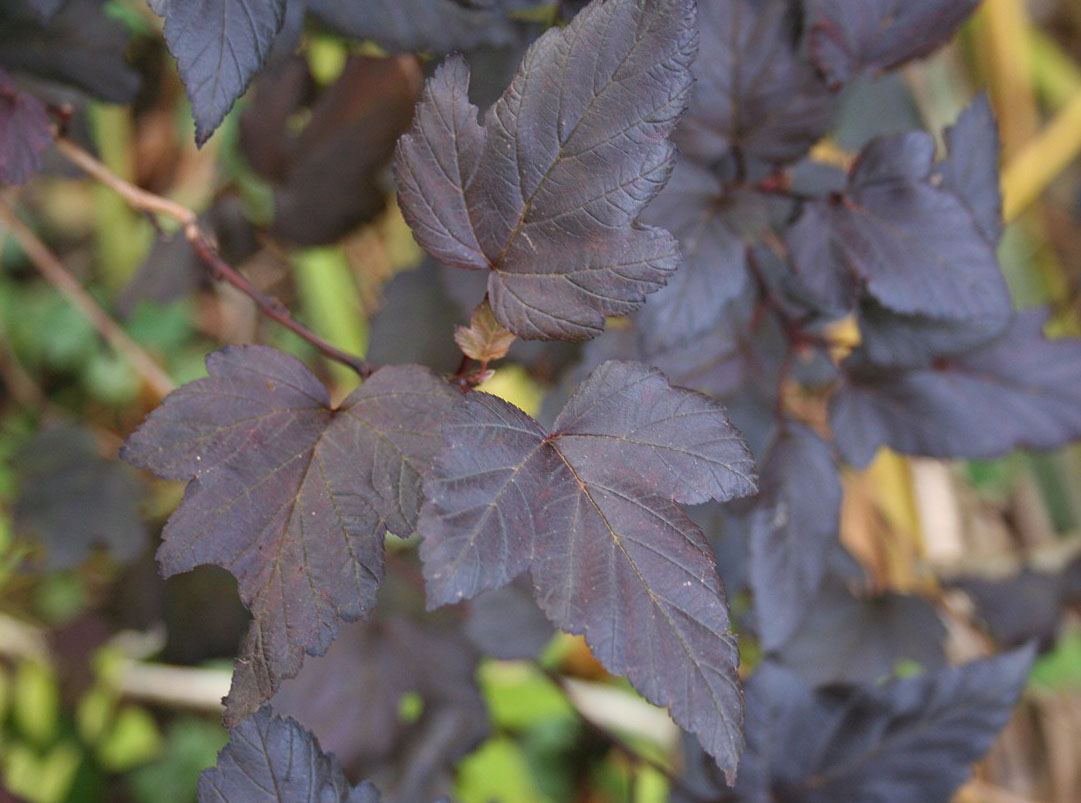
I wholeheartedly recommend ninebarks to everyone wanting a great four-season shrub. Most of them have interesting coloured foliage all gardening season, deepening to richer shades as autumn comes on. This is 'Diabolo', a purple-leafed cultivar that is an excellent, hardworking, easy care shrub.

The deciduous azaleas turn colour before losing their leaves, although they've been highly annoyed by the wind this autumn and have been more battered than colourful. This is an unnamed variety from Bill and Sharon at The Willow Garden. I have a number of their tough, beautiful rhododendron and azaleas, including several crosses that haven't been named.

Kolkwitzia is one of those plants that some refer to as old-fashioned, commonly planted and just sort of "there" in the garden. I love it for several reasons, not the least of which is the delicately luminous colour in fall foliage. 'Dreamcatcher' has richer colouring throughout the season, but mine was mown down by an errant lawnmower last year and is slowly recovering. So this is the common variety, given to me by a friend several years ago.

Barberries are excellent for fall colour. This is a seedling shrub from one of the purple leafed varieties in my garden. It's getting redder day by day.

Although the fall colour of my copper beech isn't showstoppingly brilliant, I include this photo for another reason. Beeches and oaks display a trait known as marcescence, meaning they retain their foliage for months after it has died. Usually it's younger trees that will do this, and my copper beech is only a few years old. Come winter, its coppery-brown leaves will look quite interesting--especially when there's a four-foot snowdrift surrounding the tree!

Many perennials will display some interesting fall colour as they wind down for the year. This is 'Alma Potchsche' New England aster, flowers faded but foliage still providing me with a smile.

And to wrap up, the always-wonderful foliage of Virginia creeper, catching some rays of sunlight on a day when the wind WASN'T screaming--a circumstance that has been rare this autumn, as I've mentioned before.

The montage at the top of this post includes Miscanthus 'Malepartus', showing great tints in its foliage; euphorbia 'Ascot Rainbow', which I'm hoping is going to make it through the winter here with a little care; and 'Brilliance' autumn fern (Dryopteris), which has gorgeous foliage all through the growing season.

Okay, it's over to you, fellow bloggers: what are your favourite plants for fall colour?

20 October 2010

Viburnums for Autumn Brilliance


Autumn is a season that many of us view with a mixture of joy and dread. The rainbow of foliage colours is usually particularly satisfying at this season of fading flowers and shortened days, and among the deciduous allstars of fall colour are the Viburnums.

Many of us think automatically of the snowball bush (V. opulus) when viburnums are mentioned, to which I go ick,pooh, yuk! I’m not crazy about this species because it’s very prone to attack from pests, and I don’t find the plant all that interesting. But that’s a personal taste—and what in gardening isn’t personal?
For our garden, I initially tended toward native species because birds love them so much and I was sure of their hardiness in my yard. In the past few years, emboldened by success with a doublefile and a fragrant species, I'm intent on adding others to the mix around our property.


Viburnums come in a dizzying number of species and cultivars, and I don’t profess to be an expert where they are concerned—just that I love them, which is a good start. You do have to watch the hardiness zones, as some are very frost tender here and aren't suited for the colder areas of the province. But we have plenty of choices for our gardens.
There are two of the more ornamental (i.e. commercially easily found) viburnums I couldn’t be without: the doublefile viburnum, (photo above) with its pagoda-like structure and lacey white flowers. There are several different cultivars available--I've pretty much decided mine is 'Summer Snowflake' rather than 'Mariesii'.

Since the only thing better than one doublefile viburnum is two, I've pretty much decided that next year, I'll add 'Newport' doublefile to the back garden too. I saw it showing off its fall colour at a friend's recently, and that was enough for me.

I love the fragrant viburnums, and have a hybrid Carlecephalum near my office window, where its fragrance can lull me in late spring and early summer. The fun thing with these shrubs is that you can tell this autumn what next year's bloom will be like, because the flower buds are large and obvious now. It's been so windy the past few days, I haven't gone out to take photos, however, so you'll have to take my word for it for now.

I really like V. 'Onondaga' which has great burgundy bronze colour in its new spring growth, and in its flower buds too. It has lobed leaves something like a highbush cranberry, and also has flowers somewhat similar to the doublefile or highbush cranberry viburnums, flat clusters of lacy white blooms.

Some years, we don’t get a huge amount of fall colour from our viburnums, mostly because that ever-present wind rips leaves from many of our shrubs and trees before they can get really going. However, where we lose the foliage show sometimes, the fruit of the shrubs remains colourful, and provides much-needed food for birds, which are a major part of our garden.

V. nudum var. cassinoides is the Witherod or wild raisin (photo above), a native shrub that has reddish foliage in spring and gorgeous red to purple fall foliage. White flowers in the spring give way to pink fruits that eventually turn deep rich blue, before the birds swoop in to dine on them all. It was one of the first shrubs I learned to recognize as a child, although I thought the berries were toxic, probably because they are almost the same shade of blue as Clintonia.

Viburnum dentatum or arrowwood (photo at top of post) is a tough, winter hardy species that works well as a tall hedging or screen plant for a windbreak as well as having ornamental qualities. Its common name comes from the fact that its straight stems were formerly used by First Nation peoples for the shafts of their arrows. Arrowwood has blue-black fruits in the fall and foliage that varies from yellow to coppery orange and red. 'Chicago Luster' and 'Blue Muffin' are two popular cultivars of this native shrub.
V. trilobum, the highbush cranberry, is not a cranberry at all but is a native shrub in much of Atlantic Canada. It’s attractive as a specimen plant or even as a hedge, and its white blossoms are followed by blood red, fleshy fruit and red-purple autumn colour. Although the species grows to twelve feet tall, the cultivar ‘Compactum’ reaches only half that height.

If you're looking for an excellent book on the wonderful Viburnums, do check out Michael Dirr's excellent reference book by the same name. Published by Timber Press (of course), it's an invaluable reference book, written in Dirr's wonderfully encouraging and chatty style, and illustrated numerous photographs as well as with paintings done by his wife. Just be aware--viburnums can be habit forming.
Have you been lured into the wonderful world of viburnums yet?

Search Bloomingwriter

Custom Search