31 October 2009

Happy Halloweening from the kitties!

funny pictures of cats with captions
see more Lolcats and funny pictures
If it's not one thing it's another. Been buried in work (which is good and fun and interesting and pays the bills) but also down-a-quart, healthwise. So I've been missing in action again. I told the catchildren they could do the post for Halloween but most of them weren't interested, being busy sleeping.

We don't get trick or treaters here now, because the local kids are all grown, & we're too rural for others to visit except from car. So we'll have a quiet evening of reading, whether online or actual books. And napping, in the case of the catchildren.


However, no Halloween is complete without a big black cat, so Rowdy Retread hopes everyone has a fun and safe day and evening. He isn't going trick or treating, but is good at supervising yard cleanups. And at having naps.

Mungus isn't so interested in candy treats, but he highly recommends pizza. Especially pizza that comes with a big box he can lay on afterwards for his post-pizza nap. (what's left of the pizza is in the fridge, incidentally).

I'll be back later with something more garden-related!

19 October 2009

Gardening by colour: White spring bulbs


The weather here continues to be more like November than October: cold, wet, dreary, windy, rainy, repeat as necessary. It's been annoying because the great fall colour we often get has been somewhat beleaguered by excessive wind and rain, so that many leaves are just getting to their good colour when the wind shreds and sends them away. I've done nothing outside, but am declaring a day off indoors to catch up on much neglected matters, such as blogging and cleaning the house up.

Work took me out and around the other day and I landed in unexpectedly to visit a dear friend I hadn't seen in far too long. She was taking the opportunity of a decent (if cold) afternoon to clean up her containers, bring her houseplants in, and do other garden chores I've yet to touch. Naturally, we got on to the subject of planting bulbs and of colour and of other timely subjects.

Last year I received a box of white-flowering bulbs from the International Flowerbulb Centre, and managed to get most of them planted out before snow and surgery ended my gardening year. In talking to my friend, I remarked that while I love white flowers, I wasn't sure how much most gardeners would appreciate white bulbs after a winter spent buried in snow. We're really craving colour by March, aren't we? And we're not all into doing a white garden a la Sissinghurst, are we?
My friend pointed out, wisely, that white is an excellent colour for bringing out contrast and attention to other colours. And actually, it's pretty awesome by itself, just accompanied by sparkling green foliage, as with these 'Mount Hood' daffs.

When I got home, I got thinking about white bulbs in earnest, and went back through my photo libraries looking to see what I do have planted out there. Of course, the first harbinger of spring in our garden are the valiant white snowdrops (Galanthus, top photo) which are barely out of the ground before they're blooming. They are my favourite spring-flowering bulb, bar none. We do have some white crocus ('Snowbunting', second photo from top, named for my beloved snowbirds) but mostly I do prefer other colours in crocus. But I'm really partial to white or white-bicolour daffodils of all sizes and forms, including this double 'Sir Winston Churchill'.

'Thalia' is another favourite white daff, smaller than the standard types, and highly fragrant. In our garden it blooms with the forget-me-nots so we have this lovely sea of tiny, lacy blue flowers underpinning the wonderful daffs. Makes me very happy.

The last daff-family species to bloom in our garden are the 'Poeticus' narcissus, which don't come on til late May and into June. They're very fragrant and strikingly beautiful; they're also known as 'pheasant's eye' narcissus, and if you've ever fed pheasants in your yard and gotten close enough to watch them well, you can see the description fits well.

Normally, I DON'T plant white tulips. This is one situation where I really do want outbursts of colour. There are exceptions to that sort-of-rule, mostly having to do with form. These white parrot tulips have yet to reach their full glory, but I love the green and yellow feathering on the white, ruffled petals.

The double white 'Mt Tacoma' looks more like a peony than a tulip, but I do like its clean appearance. Behind it is perhaps my favourite of the viridiflora tulips, 'Spring Green'; again, that white-and-green combo just does it for me.

Muscari, or grape hyacinths, do very well in our garden, forming lovely clumps of fragrant, brilliant blue flowers. This white hybrid 'White Magic' appeals to me very much too, and I hope it multiplies as quickly as its relatives.

Lastly, we have the 'White Festival' hyacinth, which is amazingly fragrant. I planted these in the front garden near our main door and they sent out huge waves of fragrance this past spring. The fresh gold-green foliage of 'Aztec Gold' creeping veronica on one side of them, and the almost-black new growth of Actaea 'Black Negligee' made this little combination quite appealing.

I've found focusing on these white flowers has actually brightened up my weather-dreary day, bringing some much-appreciated light into my perspective. My plan is to focus on various colours over the next few blog posts, and maybe get some conversations going with more of you again. So it's over to you--do you like white spring bulbs? What do you plant?

10 October 2009

The fruits of MY labours...

I've mentioned before that autumn isn't my best time of year, as the daylight shrinks and the garden winds down. Normally I do something to sort of prepare for the coming of winter, a yearly ritual like putting the garden to bed, filling the woodshed, and so on. It's amazing how it fortifies one's mind and soul.

This year is no exception, and thanks to my longsuffering spouse's generosity and loving support I've had a wonderful rejuvenating interlude. More about that soon, I promise. And now I'm really, really, REALLY busy with work. For which I'm extremely grateful to editors and other clients, believe me. But it's meant very much limiting my time with my blog and more importantly with visiting other friends' blogs. I figure the next two weeks are going to be insanely busy and then after that will return to the normal rhythm of work.

A couple of other little things are happening: I got a new, compact digital camera for work purposes (the kind with really good resolution that you can stick in your purse and just go with so I don't have to drag my DSLR everywhere I go) but also need to have the time to really work with it and get to know it. Unfortunately, the weather has been nothing short of hateful for the past week or so, at least when I've been home. Rain, fog, and drizzle, followed by fog, drizzle and rain. Not so conducive for good photos in the garden, at least not when it's also blowing a gale of wind.

So thank you for the concerned comments/emails/facebook PMs I've received in the past few days. All is well here, and more than well. I ask for everyone's patience. I'll visit and comment whenever possible, and post once I clear a few of the urgent deadlines off my desk. Meanwhile, let's all pause a moment to envy the art of perfect relaxation as done by Mungus.


28 September 2009

The Fruits of their Labours


I've been working on a couple of assignments that mention seedheads, berries, and other fruit forms, and that necessitated me taking a walk around the yard with my camera, looking to see what has or is in the process of setting seed. I'm not the tidiest of gardeners, and while I deadhead my container plantings, I tend to leave the perennial beds alone so that they can set seed to provide food for birds and winter interest for me.


Teasels are a mixed blessing. On the one hand, their seedheads look marvelous all winter long, especially if sheathed in ice or dusted with snow, and their seeds feed a number of songbirds. On the other hand, you need to mulch heavily under them or be prepared to dig up about 90,000 seedlings per plant next spring.

One of my favourite native plants is the witherod, or wild raisin (Viburnum nudum var cassinoides). It grows in the woods around our place but I actually planted several shrubs in our garden last year so as to encourage their spread a little more.

We have a big highbush cranberry (Viburnum trilobum) in the back garden, and it has a good crop of fruit at the moment. I expect visiting waxwings and other fruit-eaters will take care of that in coming weeks and months.

This is going to be 'quite a year for rose hips' if the rugosas are any indication.


However, they're still flowering as well as setting fruit, which makes me very happy, as the rugosas are one of my garden favourites.

Another garden favourite are the Japanese barberries, of which we have a number. The best one for fall display is the standard green one. The foliage turns awesome shades of gold, carmine, and scarlet, and the brilliant red berries look stunning against that backdrop.

Whether you call it Cimicifuga or Actaea, black cohosh is a splendid perennial. Ours are just finishing up their flowering and are forming very cool seedheads, which look neat in flower arrangements as well as waving in the autumn breezes.

Some of the clematis have finished up flowering and have gone to seed, with these pompom like tassels all but covering the vines.


Others continue to flower. This is 'Josephine', a personal favourite because it blooms for a long long time and also manages to have both double and single flowers.


I don't expect to have much for holly berries this year, either in the evergreen or in our winterberries. The male evergreen holly decided to have a traumatic winter and lost every leaf, the first time it's done that in the ten years I've had it. I cut it way back and it's rallying, but not flowering. The female, on the other hand, is more than eight feet tall in some spots, and is still flowering, hoping to catch some pollen somewhere. One of my male winterberries had an unfortunate winter, getting broken down to the ground, and the other isn't very big yet, so I don't know that it produced enough pollen for any of the plants to get fertilized. I guess we'll know in a few more weeks.
I was sent this Paniculata hydrangea to trial along with a few others several years ago. Unfortunately, the label got lost somewhere in transit and I have no idea which one this is. It might be 'Pinky Winky' because it keeps producing flowers from the tips, but I don't think it had that name when I got it. Whatever it is, it's fabulous, though not as early flowering or fast-growing as 'Quick Fire.'

My miscanthus varieties are all blooming now, with my favourite being Martin Quinn's 'Huron Sunrise.' You have to watch out for miscanthus because some spread by runners while others form well-behaved clumps. This is a clump-former.

There are still plenty of things flowering in the garden, although they're quite far-flung around the yard, unlike in high summer when there are blooms everywhere we look.

Every autumn, the colchicum surprise me with their sudden blooms. They leaf out in the spring, the foliage dies back, and I forget about them until they explode into blossom in mid-September. It's nice to have an autumn surprise like this, and I'd welcome more of this type of surprise. As opposed to the one that will happen one of these days when we get surprised by frost. Hopefully we're still some time from that, though. Yes, I'm still in autumn 'de nile' but only a little.

24 September 2009

Is there an entomologist in the (blogosphere) house?

So I'm outside this afternoon, walking around psyching myself up for my first post of autumn and determined to take the high moral ground and be cheerful and all that. I'm taking photos for a post about fruits and seeds when something on the red osier dogwood catches my eye.

"Curious," I say to myself. "How on earth did a bird manage to poop on the underside of a leaf?" I look closer and realize it's some sort of caterpillar, resting up after his meal and preparing to moult.

I meet one of his brothers/sisters/siblings, fresh out of its old skin, hungry for more munchies.

Then I discover quite a few more siblings, in various sizes and stages of growth.

They're hungry little suckers, obviously. Fortunately, this is a stand of red osier, and can take some chewed leaves with no problem. So far, anyway.

"Do you MIND? I'm trying to get undressed here!" Ooops. Pardon me, M. Caterpillar.

"Does this dress make me look fat?" Um, no, not at all. Despite how much you've been eating.

Okay, does anyone know who these creatures are, or are going to be? Because I've no idea. I'm guessing they are moths rather than butterflies (don't know why I'm guessing that, other than this is the season for pesky moths elsewhere) and are probably a nuisance. But I could be all wrong about that.

Whatever the case, I'm going to let nature police herself. I see no reason to wage any sort of warfare, biological or otherwise, unless these critters plan to take over. A look around the yard seems to indicate they're host-specific, but again, I really don't know and invite identifications.

These baldfaced wasps don't attack caterpillars, so far as I know, but they fascinate me. So long as they're not being aggressive, that is. I've never been stung by one, probably because I just watch them and let them go about their business.

We have a LOT of garden spiders, and I'm thinking about taking a few of them around to the dogwoods, just in case. Maybe they'll develop a taste for caterpillars to go along with the assorted foolish flies and other critters they've caught. Whatever the case, I'm just going to observe what happens next.


Edited to add: It seems my visitors are the larvae of the dogwood sawfly, Macremphytus tarsatus! I hit Google with a steely glint in my eye, because I love puzzles, and found a photo that looked remarkably like mine. And guess who took it? None other than our friend Nan Ondra at Hayefield. She, of course, had the problem about a month ago, which seems apt because she's about a month ahead of us in terms of plant growth. Nan writes that Btk wouldn't work on these if I did decide I was irked with them, but horticultural oil or insecticidal soap will. I'm going to go with laissez-faire, however, unless they get too pugnacious. Guess I was right about them being host-specific, too.

18 September 2009

Making a Complete Aster of Myself


It was something of a shock to discover, a few years ago, that I had fallen in love with asters. Not only that, but the love affair continues to grow and flourish. And become even broader based than I had dreamed possible.

Let me qualify that. I fell in love with the perennial, fall blooming type of asters, whether they're tall or small, blue or purple or magenta or hot pink. I've never grown annual asters so I really can't comment on them, other than to say I like their colours. But over the few years, something has clicked in my head where perennial asters is concerned, and I can't get enough of them.


This wasn't always the case. My first contact with these plants was with the wild varieties--of which there are myriad. In Nova Scotia alone, there are 18 native species (of a total of 175 species of asters in total, most of which are native to North America). Some, such as the New England and New York species, hybridize with great enthusiasm, and it's hard to tell one from another without quite a bit of skill.

I know how many native asters there are in this province because I consulted Roland's Flora, the revised and updated version of The Flora of Nova Scotia, written originally by A.E. (Doc) Roland and E.C. Smith back in the forties. I've mentioned Doc before in postings; he was a professor of botany at the Nova Scotia Agricultural College, and a plantsman par excellence. When I arrived at AC in the late 70s, Doc had just retired but maintained his office in the biology department, and came in daily--sometimes to play chess with one of his colleagues, sometimes to write, sometimes to answer questions of students like me, who would drag in all sorts of plants or parts of plants and wonder what they were.

Doc was the only plant enthusiast I've ever met who could glance at a fragment of a plant and tell you instantly the genus, species, subspecies, and if applicable, cultivar. He was a whiz with asters, and if memory serves he had a particular interest in them. He was and still is one of my hort heroes, and along with his colleague Lorne McFadden, encouraged my love of botany and of growing plants. But when I worked one summer helping to build the NSAC herbarium of native and naturalized plants, our wild asters gave me headaches as I couldn't tell many of them apart.


Flash forward to today, jodi the gardener as opposed to jodi the botany student. I don't know how many times I've planted cultivated asters--alpine varieties, tall varieties, medium varieties--only to dig them up the following season, thinking they were weeds. And by the same token, I've cultivated impressive clumps of tall white aster, wood aster, heartleafed aster....all of which some would call 'weeds'...thinking they were the gorgeous varieties I had bought one place or another.

Or else the asters I HAD bought, supposedly the deep pink varieties that I coveted, would turn out to be...well, purple. Call it blue if you wish, but they're lavender purple to me--and while they're lovely, they weren't what I wanted at the time.


Finally, however, I got smart....sort of. Several years ago, I got a couple of tall pink asters from a friend of mine, planted them in a special part of the garden--labeled them carefully, and for good measure, took a picture of exactly where they were. The next spring, I was very patient, watching carefully as shoots emerged, resisting the urge to weed anything that might be an aster! I nurtured, and watched, and got excited as a clump formed exactly where I had planted one of my friend's and where the label though faded, still existed. Then I noticed another, bushier aster growing near the first, and wondered about that...waited and nurtured it and watched and discovered one day that it was one of the wild ones. I sent this plant rather quickly to the compost heap with a heap of bad language.

Then several local nurseries kindly brought in perennial asters, not only potted but in flower, so I could see what I was getting. I've also spent a good deal of time looking at other peoples' asters, as well as the wild ones. I've decided it doesn't matter what colour they are, or whether they're wild or domestic: I love them all, now. I've embraced the wild ones that pop up in the gardens, because butterfies, bees and other pollinators love them. So our garden is home to asters wild and cultivated, named and suffering from Lost Label syndrome. And I'm all right with all of them.


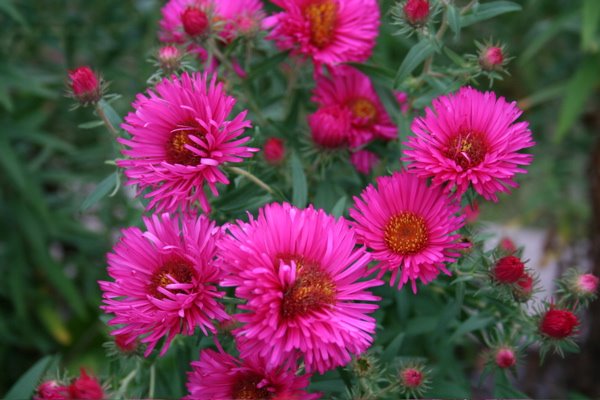
Some of the cultivated ones weren't named when I got them, so it's been amusing trying to figure out who is who; just about as challenging as trying to decide which wild species is which. I've decided this magenta cultivar is probably 'Jenny', because my sister has the same one. I think so, anyway.


This is the unusual, white flowered Puff--unusual to see a white flower at this time of year, although there are creamy white wild asters in bloom on the roadsides. It's a nice fresh counterpoint to some of the more jewel-coloured flowers currently still in bloom.


It's anyone's guess as to why this flamboyant deep-carmine marvel is named Winston Churchill, but it is. It's a low-growing type, or so far it is, and is making a really nice mound not far from Puff. The colour is clearer than the unnamed magenta variety I have, and not as hot-pink as Alma Potschke, a tall New England aster that may be my favourite overall.


This is the unique and well-named Lady in Black. No, the flowers are not black, but the foliage and stems are a deep magenta-near black. The plant smothers itself in tiny flowers and rather resembles flowery fireworks. It's a hybrid of the wild calico aster (A. lateriflorus), which I may or may not have weeded out of the garden in the past. I admit nothing where asters are concerned, when it comes to having nurtured or weeded the plants in my garden. Not any more.
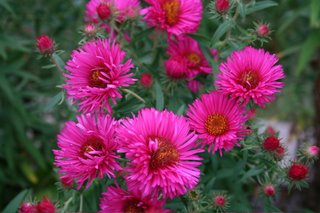

Although Alma Potschke falls over (and is amazingly difficult to spell), I forgive her because she is such a marvelously coloured flower. I call this hot-pink though you may call it fuschia or carmine or any of a number of other descriptive colours. It's not magenta--there are still lots of magenta plants flowering in my garden, but they're more like 'Jenny. My dear Dad would likely have called that particular shade 'murple', or mauve-purple. Alma he would have described as being peptobismal pink, no doubt. Whatever the case, I love Alma's brilliance-a perfect contrasting colour to all the orange and russet and gold and yellow and bronze of this time of year. I did shear some of the asters in midsummer last year, which resulted in them growing lower and bushier and producing more flowers. The trick is to remember to do the shearing at the right time of season, so as not to delay blooming too much. Or, as was the case this year...to get it done at all. It didn't get done, so I have floppy-aster syndrome.

At least I don't have to shear the wild ones. Or stake them, label them, or do anything but enjoy them. Which I'm doing in abundance. Others may call them weeds in my garden. I'm calling them pollinators and bird-feeders.

And calling myself a bit of an aster for not surrendering years ago.

Search Bloomingwriter

Custom Search