11 November 2010

Enjoy Freedom? Thank a veteran, past or present.


Today Canadians join other countries around the world as we pause and honour the sacrifices made by our veterans in wars of the past...and thank those who serve in our Armed forces today as well.

As I do every year, I offer up this heartfelt song by Nova Scotian musician Terry Kelly, "A Pittance of Time." No words are needed.


"In peace may they rest
May we never forget why they died...
...take a pittance of time."

10 November 2010

Not-so-wordless Wednesday: Literary Good News in Nova Scotia.

It's been a good couple of weeks for Nova Scotian writers, although not without its controversies. However, I'm very proud of our writers and want to celebrate them, so I'm departing from my usual garden-speak (sort of) to talk about these victories.

To begin with, those in Canada who are listeners to CBC Radio know that the MotherCorp (as it's fondly referred to by some) do a yearly broadcast called Canada Reads. The normal format is for five people, usually literate and somewhat wellknown, debate the merits of five books of Canadian fiction, and each week one book gets voted off. You know, reality tv on the radio, and purporting to be literary. The show has its aggravations, not the least of which it tends to promote books already wellknown and well-bought and read. This year, the producer decided to celebrate ten years of this program, and threw open the doors to the listeners to recommend a top 40 list, which is now whittled down to top 10, and then will be top 5.

Among the top 40 finalists were three excellent works by Nova Scotian writers. One of those has now advanced to the top 10, and I'm delighted about that, but wish the other two could have also taken a rightful spot in the top ten, rather than books that have already been on Canada Reads. The top 40 finalists included:

Heave by Christy Ann Conlin. Christy Ann Conlin lives down the Valley near Berwick, and is someone I consider a dear Facebook friend; we haven't met face to face yet (we writers can be a hermit-like bunch, especially me), but we talk back and forth and share a love for books. Heave, her first novel, burst onto the scene back in 2002, so it's been some years since I read it; at the time I read it once, had mixed emotions about it, so left it lay then revisited it later and enjoyed it much more. Christy Ann has this delectable sense of snark and humour, and her portrait of a young and somewhat tormented woman growing up in Nova Scotia could be the bio of many a young woman, regardless of geography. You can see a short review of Heave here.

The Birth House by Ami McKay. This is one of my favourite novels of all time, and not just because Ami lives here in Scotts Bay, set the novel here, and is a friend. The Birth House tells the story of young Dora Rare, growing up around the turn of the century (19th to 20th) who is successor to the community's midwife and healer, Miss Babineau. I have read this novel 6 times, which is something I do only with books that imprint themselves on my heart. This is such a novel. The Birth House has advanced to the top 10 in Canada Reads, and I hope it makes it all the way, as it is a novel everyone with a love for good writing and storytelling should embrace. To tie this into regular garden-speak on Bloomingwriter, here's a post I wrote about the plants of The Birth House.

Twenty-Six by Leo McKay Jr. Leo is no relation to Ami, but they share a passion for storytelling and an ability to grip the reader with their powerful characters and storylines. Books in Canada described the writing as "tough with a layer of vulnerability", which is accurate and one of the appeals. Set against the backdrop of the explosion of the Westray Mine in Pictou county in May, 1992, an explosion that killed 26 miners but damaged infinitely more minds and spirits, Twenty-Six isn't a tearjerker or a total gloom and doom tale. It does vividly show how an event like the Westray disaster does more than take lives, yet inspires life affirmation at the same time. Leo had a clever plan for raising the popularity of Twenty-Six on Canada Reads, and it was both fun and quite successful.

Last night, the Giller prize, the wealthiest and some say the most prestigious literary prize in Canada, was awarded to The Sentimentalists, by Johanna Skibsrud, who grew up in Nova Scotia although she now lives in Montreal. The Sentimentalists was published right here in Kings County by Gaspereau Press, a small company dedicated to quality literary printing and publishing. Their books are works of visual art to hold and touch as well as to read.

I wrote a review of The Sentimentalists a few months ago for the provincial newspaper. I reread it this morning and stand by what I wrote back then. It wasn't my favourite book ever, but I do look forward to more by Skibsrud because she does have a powerful command of language. Here's what I wrote back in the late winter:

The Sentimentalists by Johanna Skibsrud. Gaspereau Press, 2009, 27.95

Reading a book in preparation for reviewing it can sometimes be compared to making bread. Once the sponge has been kneaded, the bread is left to “rest” for a period of time before it is completed. When I finished reading The Sentimentalists, Johanna Skibsrud’s first novel, I initially was at a loss regarding how to review it, so left it alone for over a week before revisiting it.

The novel’s premise seems straightforward. The narrator’s father, a US Army veteran with the somewhat incongruous name of Napoleon, is declining in health, which coincides with an implosion in her own life. She moves him from his “palace,” a trailer in Fargo, North Dakota, to share a house in a lakeside town with Henry, the son of Napoleon’s friend Owen, who was killed in action during the chaos that was the Vietnam War.

The town, Casablanca, is a replacement for a town that was flooded to make way for a dam and that still remains beneath the lake, deeply submerged and viewed only through memory. In much the same way, personalities, emotions and stories of the main characters are only seen murkily, as if peered at through waters churned up by currents or storms. Gradually we see more of the characters and discover the haunting story that so affected Napoleon and coloured his whole life.

Skibsrud has said in interviews that the story evolved from conversations with her father, a Vietnam veteran, a year or so after the invasion of Iraq began following the events of September 11, 2001. During that earlier war, her father, then a young soldier, had witnessed the murder of a civilian woman by an army officer. He was so outraged by this event that he spoke out to his superiors, which resulted in an inquiry being held. Although the novel is inspired by this facet of Skibsrud’s family history, she stresses it is a work of fiction.

“‘Remember me when I am dead, and simplify me when I’m dead,’” Napoleon says, quoting a well-known verse by the British soldier-poet Keith Douglas, who was killed in the Normandy invasion of June 1944. Napoleon and his daughter agree that these are the words of “a rank sentimentalist” but also, the narrator writes, “like maybe everything was not such a big mystery after all.”

Before writing The Sentimentalists, Skibsrud authored of a book of poetry, Late Nights with Wild Cowboys, and her skill with word pictures shows nicely in some of the passages. However, at times the novel suffers from a lack of firmer editing. Long, meandering sentences might work well in presenting ephemeral thoughts and ideas in poetry. In this novel they’re used to such an extent that too often they serve to distract and even annoy the reader.

Gaspereau Press is well known for publishing books using quality paper and distinctive covers, creating books that are as much a pleasure to hold, as they are to read. It always puzzles me, however, that this press and others will often include long screeds at the end of a book about the typeface in which the book is set, yet say little or nothing about the artwork used in creating the cover. I particularly like the cover of The Sentimentalists, with its khaki-green illustration of a soldier sliding sideways off into the jacket flap and echoing on the back, much as the events of Napoleon’s life “have been…somewhat sideways to himself.”

As a bildungsroman, or coming-of-age novel, The Sentimentalists succeeds nicely in presenting a journey of growth and possible enlightenment in its narrator character. Where it falters a little, however, is in taking too twisted a road on the voyage in which to tell its tale. That criticism aside, it will be interesting to see what direction Skibsrud’s work takes in the future.


Small publishers/printers like Gaspereau are faced with a real dilemma when a book is nominated for awards like the Giller. Do they print a huge number of copies to go out to bookstores across the country and then have a significant portion returned to them once the glare of the publicity is off them? Or do they hold back on printing more copies until they see what will happen with the award?

Given that the paper used in the book is a particular high quality weight and variety, they have to order it in and it's not cheap nor easy to source in large quantities. Andrew Steeves, the publisher of Gaspereau (shown here on the left with his business partner Gary Dunfield (right), who keeps everything physically running smoothly at the publishing house) writes about their quandaries on their blog, which I hope you'll visit.

All in all, a great couple of weeks for Nova Scotia's literary community, and for lovers of literature everywhere, regardless of where you live. Huge and heartfelt congratulations to all involved!!

07 November 2010

A Remedy for NO-vember: spring bulbs indoors & out

It's no secret that NO-vember is my least favourite month in the calendar. The lack of light gets to me, and today, the first day of going back to Atlantic Standard Time, it's dark at just after 5 pm. We've been deluged with rain the past several days too, so it's dreary and dark and soggy outside. HOWEVER...

...I did get a significant number of spring flowering bulbs planted before the rains started. The anticipation of them is a balm for the soul--remembering springs past, and springs to come. When I plant bulbs, I think of Stan Rogers' song The Field Behind the Plow, and though I'm not planting food crops, I like to think of planting bulbs like Stan felt about planting grain or potatoes or whatever, as putting "Another season's promise in the ground."

Bulbs amaze me. Those insignificant looking little nubbly lumps of plant material disappear deep into the garden's beds and borders, sleep for a few months, then burst forth in a rainbow of colour. From the most exotic to the (some might say) humble crocus, they're all wonderful.

The tenacity and determination of Galanthus (snowdrops) delights me. Some years, they're pushing through melting snow in their haste to get up and blooming. They shrug off frosts, and multiply each year.

Are you acquainted with Leucojum, given the common name of Summer Snowflake? For many, they bloom in late spring rather than summer, but in our cooler spring garden they have held on until well into June. Think of them as something like taller, elegant snowdrops. I think they're underused and wonderful.

Another of my favourite small wonders is Puschkinia, or striped squill. It's an early bloomer too, following along after the snowdrops and usually accompanying the hellebores. This is another colonizer, great for rock gardens and front-of-border plantings.

Alliums are fabulous, deer resistant, come in all sorts of colours and sizes...some have excellent, longlasting seedheads, and some self seed, like the amusing 'Hair', which I'll show in the next post.

Another excellent and later blooming species is Sicilian honeybells, Allium bulgaricum (formerly Nectaroscordum siculum or N. bulgaricum). It's another favourite, so unique with its green, purple and white bell clusters.

The petite Iris species like I. reticulata are enthusiastic bloomers, barely clearing the soil before their colourful blossoms form a petite-pointe against the awakening soil.

For those who crave true-blue flowers, you can't go wrong with scilla, or squill, with its nodding, cobalt blue flowers. Scilla forms gradual colonies and works well under deciduous shrubs and mixed with taller bulbs such as daffodils and early to midseason tulips.
Fritillaria are another great choice for those plagued by deer and squirrels in their gardens. This is the chequered or snakeshead lily, F. meleagris. Frits can be bothered by scarlet lily beetle, although I've never encountered this as a problem.

Chionodoxa is commonly called glory-of-the-snow, and is another of my favourite small wonders for the front of borders or in rock gardens. When happy, they gradually form nice colonies in blue, white...

or pink! They are very popular with early pollinators, as are the crocus.

The first time I planted winter aconite, I put them in too soggy an area of the garden, and they didn't come back for me. This year, I've put them in what I hope is a more convivial situation (although with all this rain, everything is currently soggy!) and I hope they'll delight me with their cheery little flowers.

Don't forget to plant some bulbs for indoor colour; you can often purchase pretreated hyacinths, which you just plant and wait to bloom, or else you can buy the less expensive untreated bulbs, give them 14 weeks of cool temperatures (under 45 degrees F) and then bring them into bloom. They were a real boon to me last winter. Just the thought of them makes the day a little brighter.

Next time: the bigger, showoff bulbs: tulips, daffodils, and more alliums. Do you have all your bulbs planted yet?

29 October 2010

Skywatch Friday and a Blaze of Late-Autumn Glory

As with many of my friends and fellow gardeners around North America, I've been dealing with some erratic autumn weather this October. A week or so back, I despaired of having any real good foliage colour in the garden. But the past few days, the wind has died out, we had a couple of very good rains, the evenings have been cool and the days warm. Thursday we were bathed in a crystal blue October day here in the Annapolis Valley, and my camera and garden called me to come out and visit.

The past couple of years, my Hamamelis 'Diane' hasn't displayed much for fall colour because the wind has beaten the foliage off. But this year, the plant has been settled in and growing since 2007, it put on a lot of growth over the summer, and decided to reward me in just the past couple of days with some very satisfying colour.

Much smaller in shrub size at this time, but no less beautiful, is the native witchhazel in my garden, Hamamelis virginiana. It has cast its leaves, but a couple of them lay gleaming in the soggy grass nearby.

It's always fun when you learn about a new plant, acquire that plant, and then discover it in many different locations. This is the Gro-low Sumac (Rhus aromatica), which I read about in the course of doing my book research and which I soon after located and planted. There are a number of these low-growing sumacs planted out in Wolfville, and as they start to put on their fall finery, you can see why. I'm partial to the common Rhus typhina, always, so I knew I'd love this one too.

While I love lilacs in general, most of them flower and then are sort of uninteresting the rest of the season. Not so the dwarf Korean lilac, Syringa meyeri 'Palibin'. Not only does it sometimes put up some late-season blooms, it rewards me with a lovely buttery foliage colour, sometimes suffused with pink. I notice when checking the spelling of the cultivar name that many people don't report fall colour in their 'Palibin', so I don't know whether it's because we have colder weather, or what the story is. But you can bet I'm going to find out.

My hydrangeas are putting on some really interesting colour displays this year, and the most spectacular showoff is the awesome 'QuickFire'. I don't even know how to describe these colours other than mesmerizing. This shrub is planted not far from Miscanthus 'Malepartus', which is actually doing a good colour echo right now.

Some of the perennials are taking this opportunity to throw a few more blooms. The always tenacious catmint 'Walkers Low' is covered in drifts of tiny blue-lavender flowers.

And there are still a few amazingly blue stems of Eryngium planum, flat sea holly, sending up a cooling contrast in the lower front garden.

Finding a flower on my Ozark sundrop (Oenothera missouriensis) this afternoon was a complete surprise and thrill. Even though a bit bedraggled by last night's rain, the flower is still marvelous.

The warm weather prompted quite a bit of insect activity, including this moth on a fall chrysanthemum.

And to finish off the day, the sun rewarded us with an awesome Bay of Fundy sunset, the perfect way to celebrate Skywatch Friday.

24 October 2010

Fabulous Foliage, and Spotlight Saturday...on Sunday.


To coincide with my Chronicle Herald column for today, I thought I'd blither on a bit more about the joys of foliage for autumn. But before we get too far into my rhapsodic ramblings about leaf colour, a brief public service announcement. It's been far too long since I did a 'SpotLight Saturday' post, primarily because life got in the way what with garden season being full steam ahead, coupled with book writing and other work that pays the bills whilst book writing...Something had to give, and so the amount of time spent reading blogs fell off. Now that gardening is winding down and the days are much shorter, there's more time to read...and I like to encourage and promote other blogs, so I'll try to do these more often.

I first became aware of Dirt Gently's Horticultural Adventures because the blogger appeared in my Twitter feed as a new follower. Naturally, as a Douglas Adams fan I was completely smitten with the blog title...and a quick visit showed me this was a fun blog to follow. Great photos, and some self-effacing humour about gardening skills. The blog was only started in September, so a little encouragement from fellow bloggers is always a good thing.

Disclosure: I look after the blog for Baldwin Nurseries, and it's a work in progress. Baldwin's is one of my favourite nurseries in the province, and Robert is a good friend who loves plants, especially natives and those that are good for pollinators. So while 'he' may not comment much on other people's blogs, I do hope you'll visit and leave comments for him to enjoy. And come see the nursery, of course. It's getting a bit late in the season now, but he has plenty of great shrubs for fall and winter colour.

For those of you in Canada who watch CBC, Rob is participating in Debbie Travis's show All for One, tonight at 9 pm. I know very little about the show as I'm not a fan of home decorating shows, but I do know that tonight's show was shot in Windsor, NS. So I hope fans will tune in!

Which brings me back to blathering on about foliage. Dawn redwood (Metasequoia) is one of my favourite of non-native trees, with its graceful growth habit and interesting history. Before the needles of this deciduous conifer fall, they turn bronzy gold, and their spring colour is also bronze toned. The winter interest is in its striated, striking bark and elegant form.

A four-season beauty, the native red-osier dogwood (Cornus sericea) has some excellent colour in its foliage. Once the leaves drop, the twigs show off brilliant red colour all winter. The cultivar 'Flaviramea' has golden twigs. You need to keep this shrub well-pruned so that it has plenty of new growth--older trunks lose their winter colour.

This photo is NOT mine. Although I have two burning bushes (Euonymus alatus) in my garden, getting decent photos of them has been a challenge since they began turning colour, because of the incessant wind. So I decided to turn to Google for help, and chose this Botany Photo of the Day shot so as to also promote UBC's excellent website. In today's column, I mention how I receive regular emailed photos at this time of year, wondering what "that" shrub is with the great colour. This is "that" shrub.

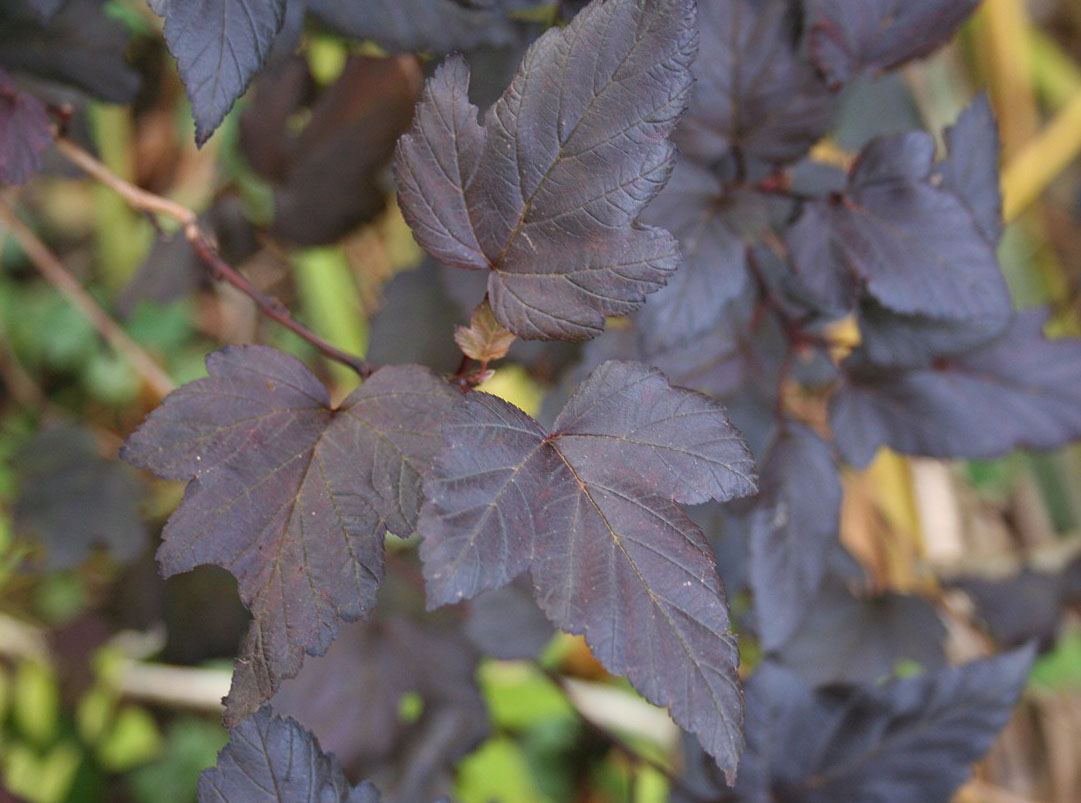
I wholeheartedly recommend ninebarks to everyone wanting a great four-season shrub. Most of them have interesting coloured foliage all gardening season, deepening to richer shades as autumn comes on. This is 'Diabolo', a purple-leafed cultivar that is an excellent, hardworking, easy care shrub.

The deciduous azaleas turn colour before losing their leaves, although they've been highly annoyed by the wind this autumn and have been more battered than colourful. This is an unnamed variety from Bill and Sharon at The Willow Garden. I have a number of their tough, beautiful rhododendron and azaleas, including several crosses that haven't been named.

Kolkwitzia is one of those plants that some refer to as old-fashioned, commonly planted and just sort of "there" in the garden. I love it for several reasons, not the least of which is the delicately luminous colour in fall foliage. 'Dreamcatcher' has richer colouring throughout the season, but mine was mown down by an errant lawnmower last year and is slowly recovering. So this is the common variety, given to me by a friend several years ago.

Barberries are excellent for fall colour. This is a seedling shrub from one of the purple leafed varieties in my garden. It's getting redder day by day.

Although the fall colour of my copper beech isn't showstoppingly brilliant, I include this photo for another reason. Beeches and oaks display a trait known as marcescence, meaning they retain their foliage for months after it has died. Usually it's younger trees that will do this, and my copper beech is only a few years old. Come winter, its coppery-brown leaves will look quite interesting--especially when there's a four-foot snowdrift surrounding the tree!

Many perennials will display some interesting fall colour as they wind down for the year. This is 'Alma Potchsche' New England aster, flowers faded but foliage still providing me with a smile.

And to wrap up, the always-wonderful foliage of Virginia creeper, catching some rays of sunlight on a day when the wind WASN'T screaming--a circumstance that has been rare this autumn, as I've mentioned before.

The montage at the top of this post includes Miscanthus 'Malepartus', showing great tints in its foliage; euphorbia 'Ascot Rainbow', which I'm hoping is going to make it through the winter here with a little care; and 'Brilliance' autumn fern (Dryopteris), which has gorgeous foliage all through the growing season.

Okay, it's over to you, fellow bloggers: what are your favourite plants for fall colour?

22 October 2010

Skywatch Friday: The last rose of summer...or not?

Since autumn's official arrival, we've had an amazing amount of wind here on the upper Bay of Fundy. Wind scouring in off the Bay can be hard on plants, tearing foliage off (especially when accompanied by heavy rain) and sometimes doing serious damage to plants and other structures.

This rose, however, photographed in one of the small communities a little further down the shore from Scotts Bay, is oblivious to the weather, still blooming in late October. I have roses still blooming too, but this one right on the shore deserved accolades. So it's my choice for Skywatch Friday.
Meanwhile, it's another windy day here, and the Bay is roiling and threatening accordingly. Hard to believe it's the same tranquil body of water that we go fishing on in warm weather. Those days, probably, are done for this year. And it looks like we're heading into a record breaking season of wind. Keeps the dust down, right?

21 October 2010

Punting garden gnomes & other true-ish tales: How to Survive a Garden Gnome Attack


The following is a true story.
I dislike garden gnomes immensely. I don't know if I suffered trauma as a child by having one fall on my foot, or if I was stalked by one as a college student studying horticulture, or what the rationale might be. All I know is that I've never seen the appeal of them, and that one on television flogging some travel site makes me want to punch the television. There were never any gnomes in my family's gardens, and suffice it to say there have never been, nor will there ever be, any in mine.

A few years ago, I was on a plant hunting expedition in Labrador, which is the northern part of Newfoundland, the part stuck to the rest of North America. Through some sort of series of errors, the place where we were all staying was overbooked, and I was the (not) lucky one who got to stay somewhere else...which was at the worst B & B I have ever encountered. Between the musty bed and bedclothes, the religious homilies festooning every wall, counter, and other surface, and the shower/bath with no mat and the world's slipperiest tub (I still bear the scar on my shin), it was, quite frankly, the night from hell. About 4 am, I gave up trying to sleep in the musty, too-hot room, packed up my suitcase, and left, planning to sleep in my car the rest of the night. I'd already paid for the night, lest anyone think I skipped out. I wouldn't do that, no matter how peeved I was.

But out by the parking area, there were two stupid, tacky, cement gnomes, sitting there in their very gnomeness. In the dark, I encountered one by banging into it with my sandal-clad foot. This just increased my irritation. Both gnomes were then gnocked over. It might have been the wind.

At least I didn't do what one of my friends said I should have done, the next morning after having breakfast with the rest of them. His idea was that I should have kidgnapped one of the gnomes and taken it to Gros Morne, placed it on the summit of the mountain. Gno, thank you. I would never pollute Gros Morne in such a way. There's rules against degradation of nature, you know.

All this is by way of prefacing my review of Chuck Sambuchino's new book, "How to Survive a Garden Gnome Attack." It was sent to me several weeks ago by Ten Speed Press, and I just got around to reading it this week.


I had long suspected that gnomes were an evil lot, bent on world domination. It's as plain as the gnose on your face that they're also in cahoots with the evil goutweed, which grows just the right height for gninja gnomes to hide in. Can you see the evil little devil hiding in this patch of goutweed? GNo? Works well, doesn't it?

Okay, the book. It's hilarious and creepy, all at the same time. It depends on your sense of humour, (or in some cases, lack thereof). Sambuchino writes well, and while the tone is deeply serious to reflect the danger lurking in lawn warriors, the reader can't help but hope that the author didn't bite his tongue too often whilst writing, as it was firmly planted in his cheek.

Do YOU know how to gnomeproof your yard and garden? Do you know how to secure your home so that these little monsters can't get inside for an attack? Sambuchino leads us through everything you need to know about coping with these insidious, nefarious creatures. You can survive when they attack, and Sambuchino proves how they inevitably will get cocky enough to make an attempt on your life. Fortunately, he's the man with the answers, though I was expecting some reference to duct tape and plastic sheeting in there, too.

A mention of the Battle of Thermopylae should give the history buff amongst readers some understanding of how to oppose gnomes in battle. There's even some recommendation about how to dispose of the dangers of "roaming gnomes." My personal favourite is to dispose of said creatures in the Laurentian Abyss, one of the deepest parts of the Atlantic Ocean, but in case of emergency, probably leaving a gnome at the door of any mall on Black Friday will do the trick.

Now, let me stress, this isn't high-faluting "Litter-a-chur", nor is it an essential for the gardener's library in order to increase one's gardening abilities. What it is, is very good fun, a nice addition as part of a gift basket or as stocking stuffer for a gardener or for anyone who has ever muttered about the clutter of gnickgnacks on lawns and in homes. We all need a little more humour in our lives.

And far, far, fewer gnomes.

20 October 2010

Viburnums for Autumn Brilliance


Autumn is a season that many of us view with a mixture of joy and dread. The rainbow of foliage colours is usually particularly satisfying at this season of fading flowers and shortened days, and among the deciduous allstars of fall colour are the Viburnums.

Many of us think automatically of the snowball bush (V. opulus) when viburnums are mentioned, to which I go ick,pooh, yuk! I’m not crazy about this species because it’s very prone to attack from pests, and I don’t find the plant all that interesting. But that’s a personal taste—and what in gardening isn’t personal?
For our garden, I initially tended toward native species because birds love them so much and I was sure of their hardiness in my yard. In the past few years, emboldened by success with a doublefile and a fragrant species, I'm intent on adding others to the mix around our property.


Viburnums come in a dizzying number of species and cultivars, and I don’t profess to be an expert where they are concerned—just that I love them, which is a good start. You do have to watch the hardiness zones, as some are very frost tender here and aren't suited for the colder areas of the province. But we have plenty of choices for our gardens.
There are two of the more ornamental (i.e. commercially easily found) viburnums I couldn’t be without: the doublefile viburnum, (photo above) with its pagoda-like structure and lacey white flowers. There are several different cultivars available--I've pretty much decided mine is 'Summer Snowflake' rather than 'Mariesii'.

Since the only thing better than one doublefile viburnum is two, I've pretty much decided that next year, I'll add 'Newport' doublefile to the back garden too. I saw it showing off its fall colour at a friend's recently, and that was enough for me.

I love the fragrant viburnums, and have a hybrid Carlecephalum near my office window, where its fragrance can lull me in late spring and early summer. The fun thing with these shrubs is that you can tell this autumn what next year's bloom will be like, because the flower buds are large and obvious now. It's been so windy the past few days, I haven't gone out to take photos, however, so you'll have to take my word for it for now.

I really like V. 'Onondaga' which has great burgundy bronze colour in its new spring growth, and in its flower buds too. It has lobed leaves something like a highbush cranberry, and also has flowers somewhat similar to the doublefile or highbush cranberry viburnums, flat clusters of lacy white blooms.

Some years, we don’t get a huge amount of fall colour from our viburnums, mostly because that ever-present wind rips leaves from many of our shrubs and trees before they can get really going. However, where we lose the foliage show sometimes, the fruit of the shrubs remains colourful, and provides much-needed food for birds, which are a major part of our garden.

V. nudum var. cassinoides is the Witherod or wild raisin (photo above), a native shrub that has reddish foliage in spring and gorgeous red to purple fall foliage. White flowers in the spring give way to pink fruits that eventually turn deep rich blue, before the birds swoop in to dine on them all. It was one of the first shrubs I learned to recognize as a child, although I thought the berries were toxic, probably because they are almost the same shade of blue as Clintonia.

Viburnum dentatum or arrowwood (photo at top of post) is a tough, winter hardy species that works well as a tall hedging or screen plant for a windbreak as well as having ornamental qualities. Its common name comes from the fact that its straight stems were formerly used by First Nation peoples for the shafts of their arrows. Arrowwood has blue-black fruits in the fall and foliage that varies from yellow to coppery orange and red. 'Chicago Luster' and 'Blue Muffin' are two popular cultivars of this native shrub.
V. trilobum, the highbush cranberry, is not a cranberry at all but is a native shrub in much of Atlantic Canada. It’s attractive as a specimen plant or even as a hedge, and its white blossoms are followed by blood red, fleshy fruit and red-purple autumn colour. Although the species grows to twelve feet tall, the cultivar ‘Compactum’ reaches only half that height.

If you're looking for an excellent book on the wonderful Viburnums, do check out Michael Dirr's excellent reference book by the same name. Published by Timber Press (of course), it's an invaluable reference book, written in Dirr's wonderfully encouraging and chatty style, and illustrated numerous photographs as well as with paintings done by his wife. Just be aware--viburnums can be habit forming.
Have you been lured into the wonderful world of viburnums yet?

Search Bloomingwriter

Custom Search